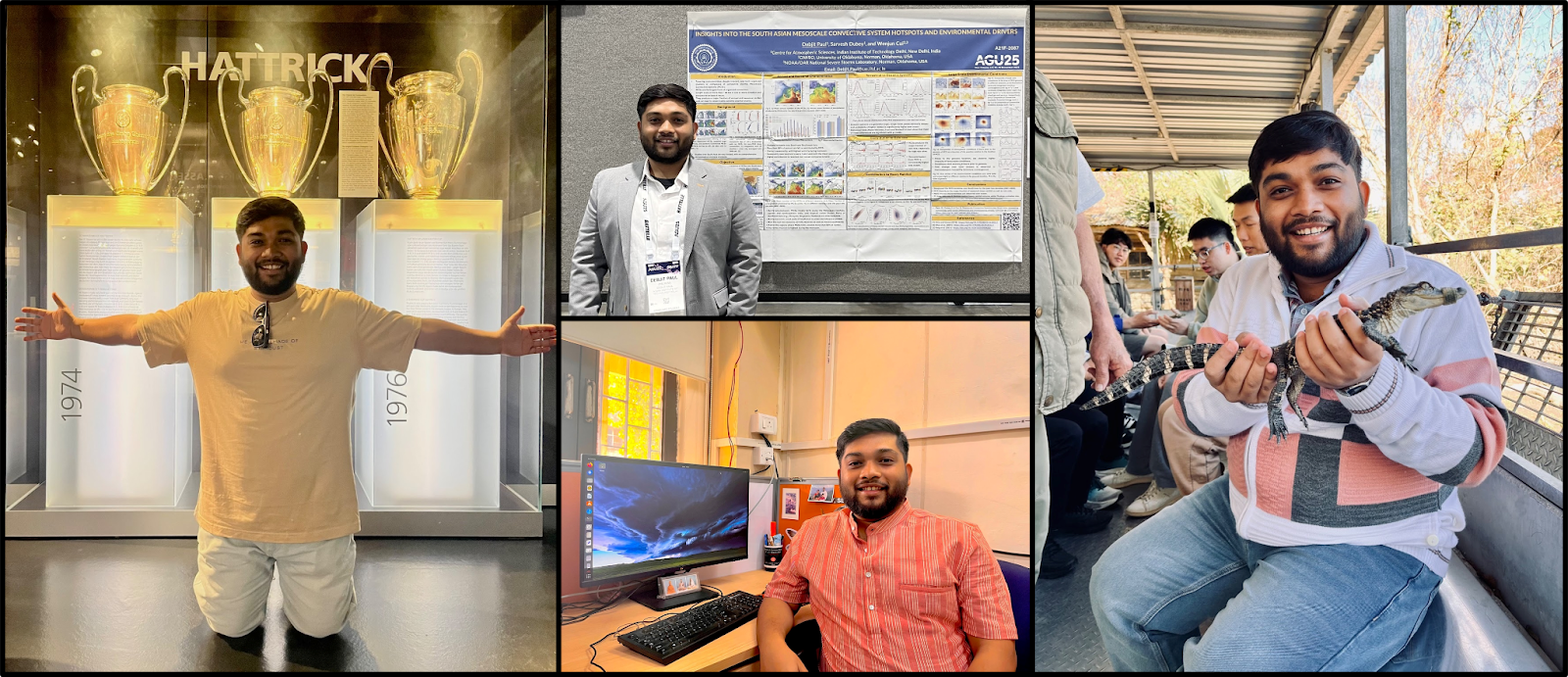
- Where are you from, where did you receive your education, and what in?
I am from Kolkata, West Bengal, a city known as the cultural capital of India. Kolkata has a rich historical legacy, having served as the capital of British India until 1911. The city is renowned for its intellectual heritage, literature, art, and scientific contributions. I did my Bachelors in Chemistry (Hons.) from Ramakrishna Mission Vidyamandira and Masters in Atmosphere and Oceanic Sciences from Indian Institute of Technology Bhubaneswar. Currently, I am pursuing PhD at the Centre of Atmospheric Sciences, Indian Institute of Technology Delhi.
- What first got you interested in the topics you chose to study?
To be honest, I did not initially plan to study atmospheric sciences. During school, I loved Chemistry, which led me to pursue a BSc in Chemistry. However, life took an unexpected turn when I joined the School of Earth, Ocean and Climate Sciences at IIT Bhubaneswar for my Master’s. In the initial months, I was genuinely in a dilemma. I was unsure whether I truly belonged in this field. The only aspect I felt naturally drawn to was coding and data analysis. Everything changed in my second semester when we were introduced to the Wheeler and Kiladis diagram. I was fascinated, especially by MJO, and how a planetary-scale disturbance could modulate tropical convection across vast regions felt both beautiful and profound.
Growing up in Kolkata, I frequently experienced “Kalbaisakhis”, the intense pre-monsoon thunderstorms that brought relief from the heat but sometimes caused severe damage. Gradually, I began connecting these experiences. I became curious about how large-scale phenomena like the MJO might influence regional thunderstorms and lightning activity over India. This curiosity shaped my MSc thesis, where I explored the link between the MJO and lightning and thunderstorm activity over India, trying to understand the multi-scale interactions governing convective systems. By the time I began my PhD, my interest had matured into a broader scientific question: how does organized convection evolve, intensify, and produce high-impact extreme events? This naturally led me to study MCSs, allowing me to examine convection from synoptic to mesoscale perspectives and to better understand the dynamics, thermodynamics, and societal impacts of extreme precipitation events.
- How has your area of research evolved since you first started doing research?
My research has evolved both conceptually and technically since I first started. During my Master’s, I was primarily interested in understanding how large-scale phenomena like the MJO modulate regional thunderstorm and lightning activity over India. At that stage, my focus was on identifying connections across scales and building a strong foundation in atmospheric dynamics and data-driven analysis. During my PhD, my perspective broadened significantly. Rather than only examining how large-scale variability influences convection, I began investigating the internal dynamics, thermodynamics, and microphysical processes of organized systems themselves, particularly MCSs. My work now focuses on how these systems evolve, organize, and produce high-impact extreme precipitation events during the Indian Summer Monsoon.
Methodologically, my research has also become more integrated. I combine satellite observations, reanalysis products, and high-resolution numerical simulations to examine convection from synoptic to cloud-resolving scales. This multi-scale and multi-platform approach has allowed me to move from studying modulation mechanisms to understanding structure, feedback, and societal impacts. Looking ahead, I aim to further bridge the gap between process-level understanding and predictability, particularly in the context of extreme weather under a changing climate. Ultimately, I hope my work contributes not only to advancing mesoscale meteorology but also to improving risk assessment and early warning frameworks.
- Where do you see your area of research headed in the future?
In the long term, I believe my research will contribute to both fundamental advances in tropical meteorology and practical improvements in extreme weather prediction and climate resilience. In the future, the key challenge will not just be understanding MCSs, but improving their predictability and quantifying how their structure, intensity, and frequency may change under climate variability and long-term warming.
With increasing computational power and high-resolution modeling, we are now able to explicitly resolve convective processes that were previously parameterized. I believe the field will increasingly combine cloud-resolving simulations, satellite observations, and machine learning techniques to better capture multi-scale interactions. Another important direction is translating process-level insights into societal relevance. As extreme precipitation events become more frequent and intense over regions like South Asia, bridging the gap between mesoscale dynamics and impact-based forecasting will be crucial. This includes improving early warning systems and understanding compound extremes.
- What is your favorite part of your job?
“Service to man is service to God,” a principle articulated by Swami Vivekananda, is something I deeply resonate with. I believe this should be the ultimate goal of every research endeavour. Studying extreme weather systems is not just an academic pursuit for me, it carries a strong sense of societal responsibility. Severe storms, MCSs, and extreme rainfall events directly affect lives, livelihoods, and infrastructure, particularly in vulnerable regions around the globe.
The favorite part of my job is knowing that the science I work on has the potential to contribute, even in a small way, to better understanding and prediction of such high-impact events. There is something profoundly meaningful about translating complex atmospheric dynamics into knowledge that can ultimately support preparedness and resilience. At the same time, I genuinely enjoy the intellectual side of research, the process of coding, analyzing large datasets, and uncovering patterns within the chaotic and super-complex climatic system.
- What are some of your hobbies?
In my free time, I enjoy photography, especially capturing landscapes and candid moments. I have a pet dog named Pori (means “Angel”), and spending time playing with her is something I truly cherish. I also enjoy playing and watching football and cricket. I am a huge fan of Real Madrid football club. Whenever I get the chance, I love traveling to the mountains.
- Who has inspired you most throughout your career?
My mother is my primary source of motivation. Her strength, sacrifices, and constant encouragement have been the foundation of everything I pursue.
I am deeply grateful to everyone who has supported and inspired me along the way. My advisors, Dr. Sarvesh Dubey (PhD Supervisor) and Prof. Kiranmayi Landu (MSc Project Supervisor), have played a pivotal role in shaping my academic journey. They taught me what it truly means to be a thoughtful and rigorous researcher. I am also constantly inspired by my collaborators, especially Dr. Wenjun Cui and Prof. Parthasarathi Mukhopadhyay, my colleagues, and friends, from whom I continue to learn new ideas and perspectives.
Above all, I remain profoundly thankful to the Almighty, for blessing me with everything I have and how far I have come.
↑ top