AGU Seismology Section News (March 2026)
Table of Contents
- Introduction
- Recap of the AGU25 Annual Meeting
- Looking Ahead to the AGU26 Annual Meeting
- Seismology Section Activities Related to the Wider AGU
- AGU Seismology Early Career Activities
- Available Seminars and Webinars
- Seismology Tidbit
(1) Introduction
As we approach the first equinox of 2026, we are excited to share the latest news and happenings of the Seismology Section in this newsletter, and also ways for you to have your voice heard. Thank you to everyone who recently nominated colleagues for AGU Honors and awards; it is an excellent way to recognize the great science and outreach of our section members. We also thank the many volunteers serving on the Honors Committees to evaluate the nominations. If you are interested in becoming more involved in the Section and want to hear more about the responsibilities, please reach out to President-Elect Ed Garnero.
(2) Recap of the AGU25 Annual Meeting
It was super to see all those able to travel to New Orleans for the AGU25 meeting, which had an excellent seismology program. Thank you to our 2025 Section Program Committee, William Frank and Helen Janiszewski.
Access to recorded sessions and online posters is available to meeting registrants until 14 April, so there is still time to view presentations you missed.
A short business meeting preceded the Beno Gutenberg Lecture, where Rachel Abercrombie, Section President, was able to thank sponsors and volunteers and congratulate all awardees from the Seismology Section. Martha Savage, Past President, presented the Seismology Keiiti Aki Early Career Award to Jiaxuan Li, and Rachel introduced Jeroen Tromp, the Gutenberg Lecturer. Jeroen presented a fascinating and impressive overview of the development and status of global full-waveform inversion. The recording of the lecture is currently available to AGU registrants and will be made available to all after the end of the hybrid meeting access period.
The Seismology Section Early Career events at AGU25 are described in Section 5 below.
(3) Looking Ahead to AGU26
We are excited to announce the Section’s new AGU26 Annual Meeting Chair, Helen Janiszewski, and Co-Chair, Dara Goldberg. As members of the Annual Meeting Program Committee, they will work to develop and organize the scientific program, ensuring that we will have an innovative and impactful Annual Meeting.
AGU26 will take place 7–11 December 2026 in San Francisco, California. Members were invited to submit a scientific or union session, town hall, or scientific workshop proposal by 22 April. See the AGU26 session proposal information.
- Scientific sessions: Can cover a single AGU section or be collaborative across sections.
- Union sessions: Focus on topics of broad interest that resonate with the entire Earth and space science community.
- Town halls: Best for collecting feedback, raising awareness, or providing updates on programs.
- Scientific workshops: Free from the formal constraints of traditional scientific sessions, workshops provide a way to share knowledge and skills while promoting discussion among attendees.
For session proposals, the program committee does not assign final session allocations—oral, poster, GeoBurst, or eLightning—until after the abstract submission deadline. If you are thinking of submitting a session and are interested in an eLightning or GeoBurst session, please reach out to Helen or Dara. Feedback from last year suggested that these sessions worked best when preplanned.
Important AGU26 dates and deadlines:
- 22 April — Session, town hall, and scientific workshop proposals close.
- 5 August — Abstract submissions close.
- 7–11 December — AGU26 Annual Meeting.
OSPA Update
Many aspects of AGU25 needed to be reimagined during a very uncertain year. As a result, a strategic decision was made to pause the Outstanding Student Presentation Award (OSPA) Program and instead explore a related approach focused on supporting first-time presenters. Section Leaders, including Rachel and Ed, and others met during AGU’s March Council meeting to discuss the future of the program and provide feedback on a proposed strategy to support emerging scientists and those in transition presenting at AGU conferences. The goal is to build on OSPA’s tradition of recognizing outstanding presenters while evolving the model to reduce the significant volunteer effort.
AGU is continuing to gather feedback from member stakeholders, including an advisory group, and expects to have a plan in place ahead of the AGU26 abstract-submission period. More details on potential volunteer roles will be shared in the coming months as plans for AGU26 are finalized. We know you care about our students and want to help them be successful, and volunteers like you will still be needed to ensure that support.
If you have other feedback to guide planning for the next meeting, please contact any member of the Section leadership.
(4) Seismology Section Activities Related to the Wider AGU
Report from the Council Meeting (Rachel and Ed)
As Section President and President-Elect, Rachel and Ed join the other section leaders for two AGU Council Meetings per year, the most recent being in Washington, D.C., in early March. Here we learn what the AGU headquarters staff are working on, so that we can share it with you, and represent the membership in discussions. We provide feedback to guide plans for the Annual Meeting, Honors and student-recognition programs, and all other AGU activities, including new initiatives. We are always glad to hear your views so that we can represent you as effectively as possible. These Council meetings are also a wonderful opportunity to meet the AGU leadership, see their dedication and hard work, and learn more about running our professional society, actively promoting its members, and advancing the science we value.
AGU Days of Action: April Congressional Visits Day Event
As part of its ongoing Days of Action programming, AGU is excited to support a special Congressional Visits Day event on 21–22 April 2026, bringing scientists in the United States directly to Capitol Hill to advocate for the value of science. U.S. federal policy decisions have a direct impact on science funding, research priorities, and the role of science in society, and scientists have a critical role to play in those conversations. One of the most effective ways to influence science policy is through in-person meetings with Members of Congress and their staff. Thank you to any members who signed up. Please contact Rachel if you participated; we would be glad to hear about your experience and support you. Look out for deadlines to join future Congressional Visits Days.
If going in person is not for you, the 45,000 emails and 3,000 phone calls made by 13,000 AGU scientists to U.S. legislators in 2025 are also having an effect in raising awareness, with Congressional staff commenting on them during recent visits. Learn more about AGU Days of Action. AGU is also working more internationally to promote science policy, so this is not only for U.S. members.
Comment on Draft AGU Position Statements
AGU members had until 31 March to comment on revisions to three AGU position statements addressing Earth and space science education, government support of science, and the responsibilities and rights of scientists. Position statements enable AGU to provide scientific expertise on significant policy issues to stakeholders such as policymakers and educators. Members can review AGU’s Position Statement on the Responsibilities and Rights of Scientists and other current position statements on the AGU website.
(5) AGU Seismology Early Career Activities
The Seismology Section Early Career team, pictured below in New Orleans with other members of the Seismology leadership, organized three separate events at AGU25.
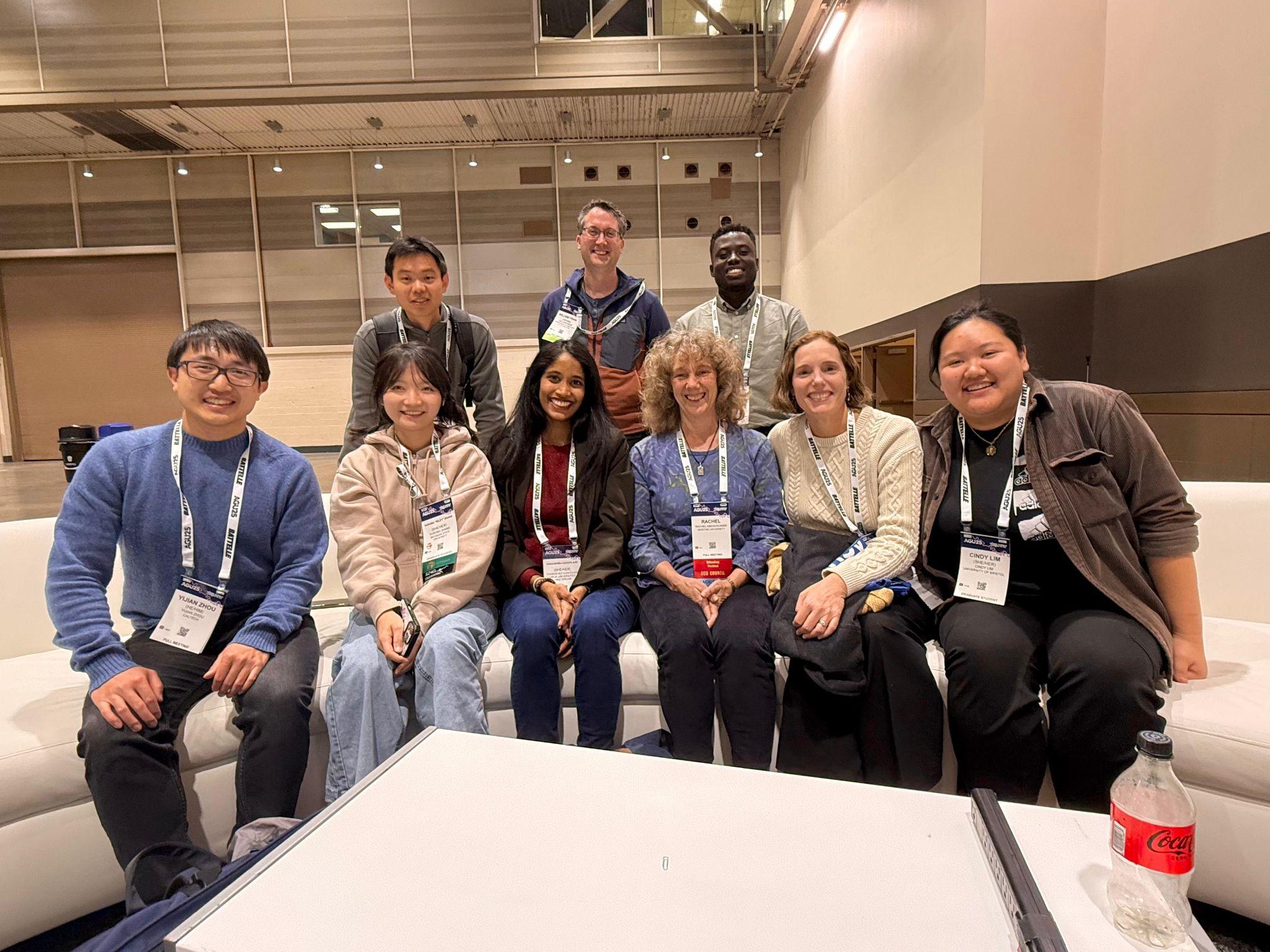 Front row: Yijian Zhou, Yurong Zhang, Thanushika Gunatilake, Rachel Abercrombie, Elizabeth Cochran, and Cindy S. Y. Lim. Back row: Yifan Yu, William Frank, and Richard Asirifi.
The AGU25 Seismology Section Student–ECR Networking Luncheon
At AGU25, the Seismology Early Career Researcher Executive Committee hosted a highly successful luncheon and networking mixer, bringing together over 50 student and early-career members from the Seismology Section. The event provided a valuable opportunity for professional networking, including engagement with representatives from our Seismology event sponsors: CERI at the University of Memphis; Geophysical Deep Sensing Technology; Instrumental Software Technologies; KBR; Kinemetrics; Nanometrics; and Terēan.
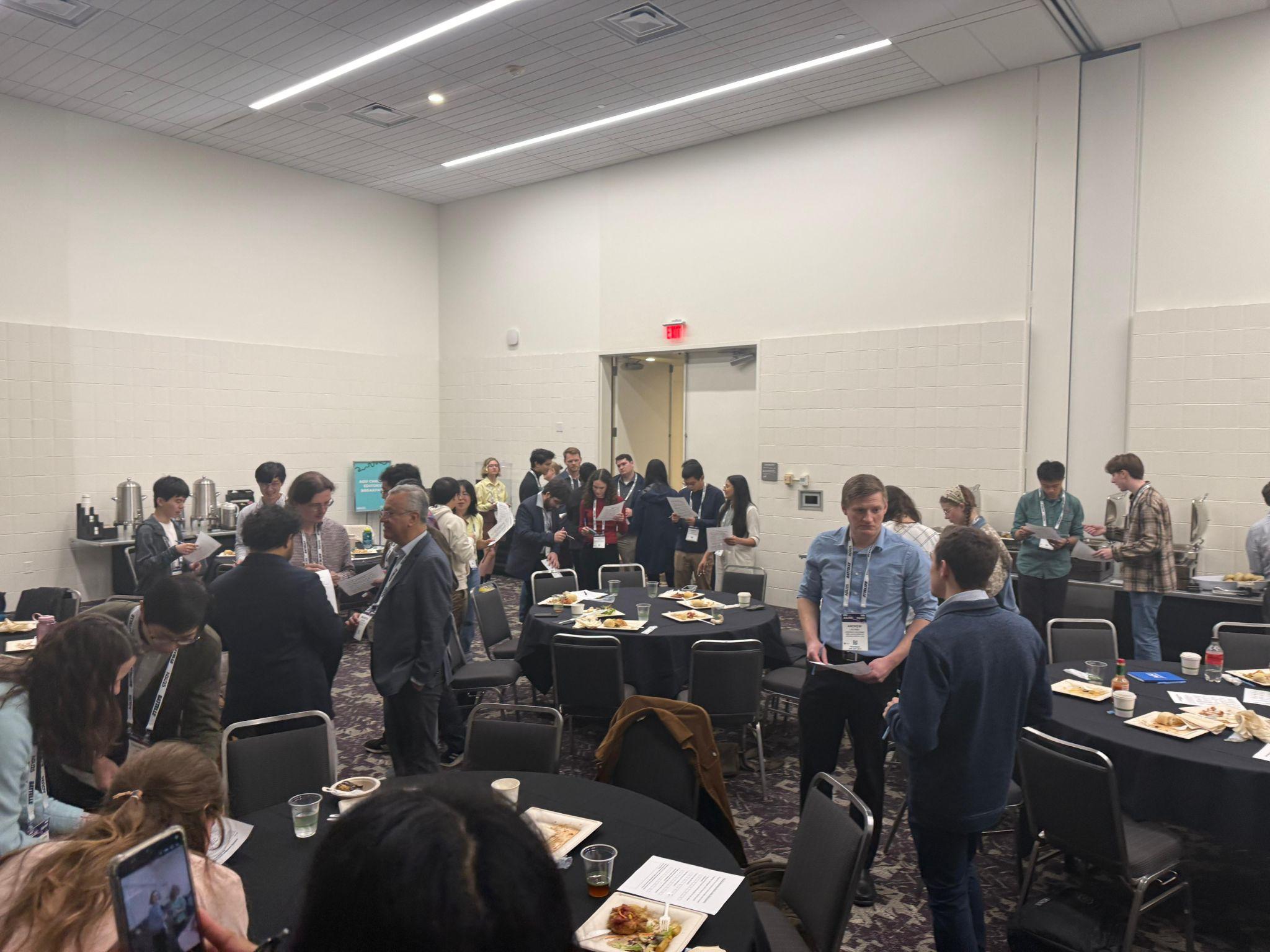
The luncheon also facilitated mentorship and discussions across career stages, with participation from five distinguished invited researchers, pictured below with members of the Seismology leadership team who also attended.
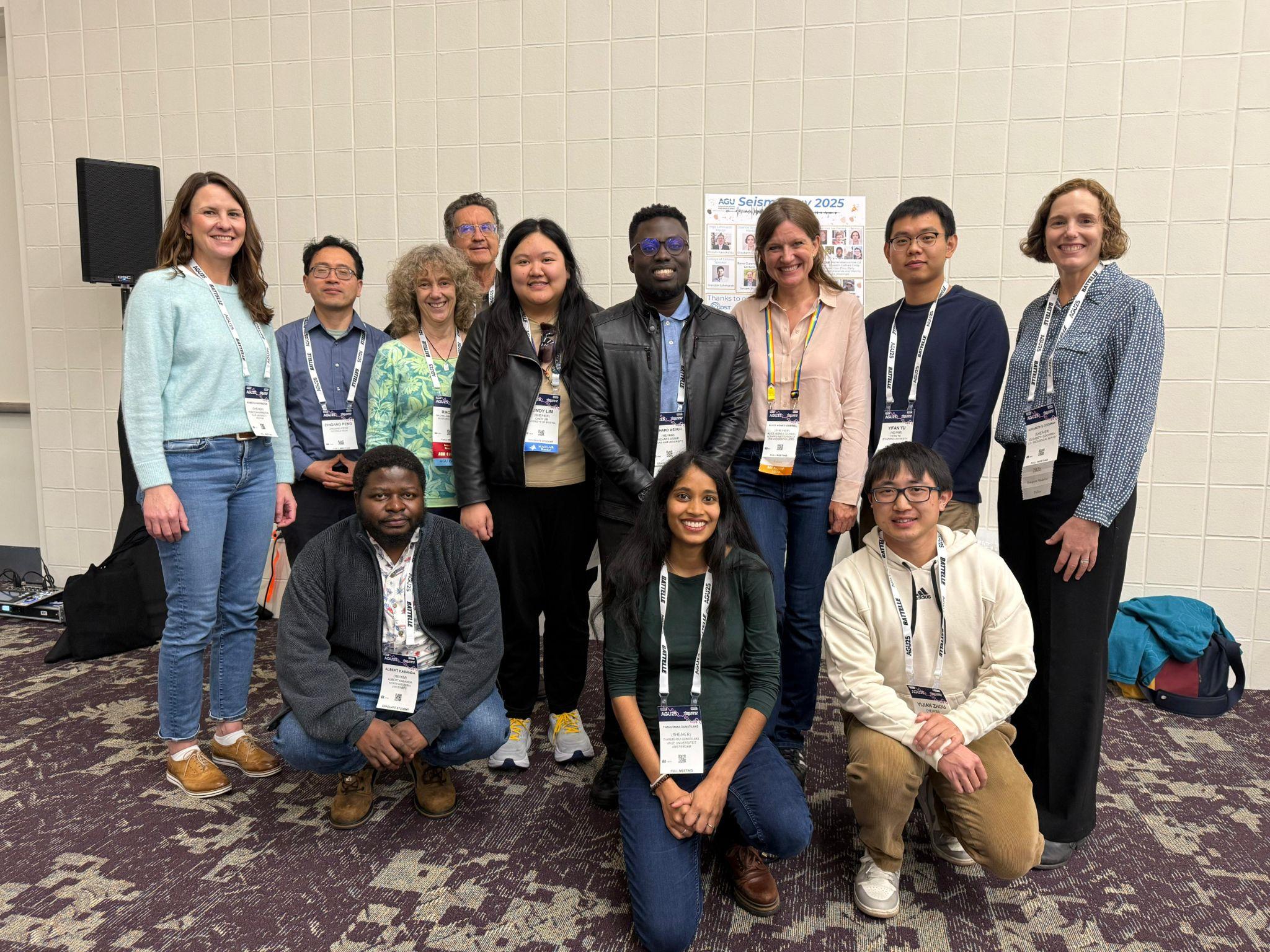 Standing: Prof. Rebecca Harrington (Ruhr University Bochum), Prof. Zhigang Peng (Georgia Institute of Technology), Rachel Abercrombie, Prof. Greg Beroza (Stanford University), Cindy S. Y. Lim, Richard Asirifi, Prof. Alice-Agnes Gabriel (Scripps Institution of Oceanography, UC San Diego), Yifan Yu, and Elizabeth Cochran. Front: Albert Kabanda, Thanushika Gunatilake, and Yijian Zhou.
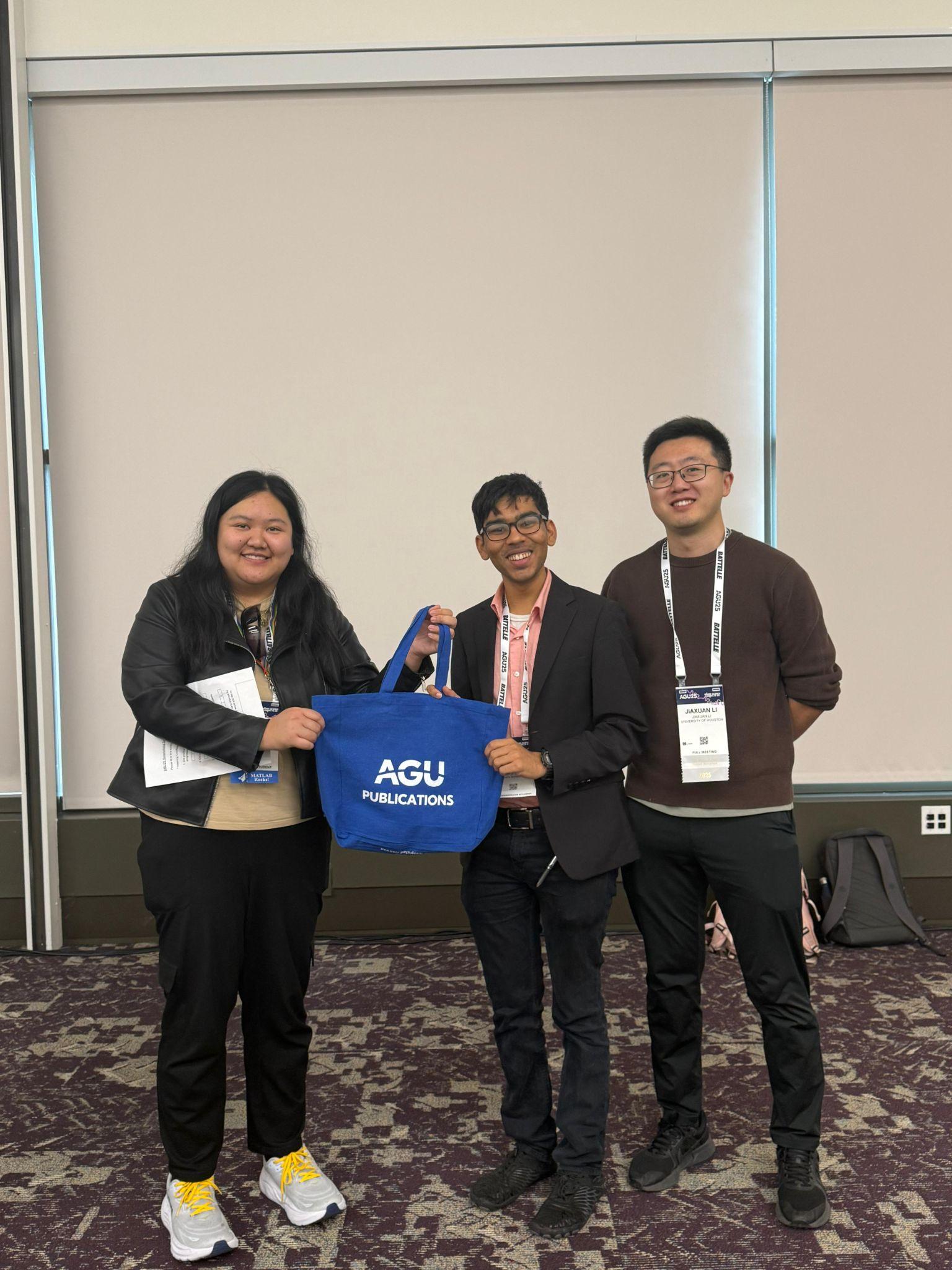
Luncheon attendees engaged in lively conversations, shared Seismology-themed experiences, and built new professional connections. A highlight of the event was the Seismology-themed bingo, or “Seismo-Bingo,” which offered a fun and interactive way to network with other researchers. Congratulations to our two winners, pictured below being presented with their AGU-themed prizes—socks—and the AGU25 mascot, Pelly the Pelican, by Cindy after successfully completing their networking bingo cards. Overall, it was an engaging event that demonstrated a strong sense of community within the AGU Seismology Section.
Faultless Friendships Network at AGU25
Navigating a large scientific meeting like the AGU Annual Meeting can be both exciting and overwhelming, especially for students and early-career researchers. To help foster meaningful connections and create a more welcoming experience, the AGU Seismology Section Early Career Researcher Executive Committee organized the “Faultless Friendships” Network System at AGU25.
The initiative brought together participants from a wide range of institutions and career stages, forming small, mixed groups designed to encourage peer support, networking, and shared conference experiences. In total, participants were organized into seven in-person groups and one virtual group, reflecting the program’s inclusive approach and global reach.
The goal was to create friendly, low-pressure spaces where participants could connect and navigate the meeting together. For many, the program achieved this. Participants attended each other’s poster presentations, organized informal meetups, and built meaningful connections beyond their home institutions. Some groups extended these interactions outside the conference, meeting for meals, exploring the city, and even visiting local attractions such as museums together, creating a more memorable and personal conference experience.
The inclusion of a virtual group also ensured broader accessibility, allowing participants who could not attend in person to engage with peers.
Overall, Faultless Friendships fostered a sense of community and provided an approachable way for students and early-career scientists to connect within the large AGU environment. The positive engagement highlights its strong potential as a continuing initiative to support networking and inclusion within the Seismology community.
The AGU25 Inter-Section Trivia Night
The Seismology ECR Executive Committee also co-hosted the popular Inter-Section Trivia Night with the Study of Earth’s Deep Interior, Tectonophysics, Geodesy, and Mineral and Rock Physics sections. The AGU Trivia Night was a great success, with 120 tickets sold and an enthusiastic crowd filling the room. Participants formed eight teams and competed across a variety of fun and challenging categories, including “Geoscience on the Big Screen,” “Geology and Human History,” “Famous Rocks and Landforms,” and “Geosciences in the News.”
After several exciting rounds, Plutonic Friends, American Geoquizical Union, and Magma Cum Laude rose to the top, earning bragging rights and mineral samples as prizes. The event brought together students and geoscience enthusiasts for an evening of learning, teamwork, and friendly competition.
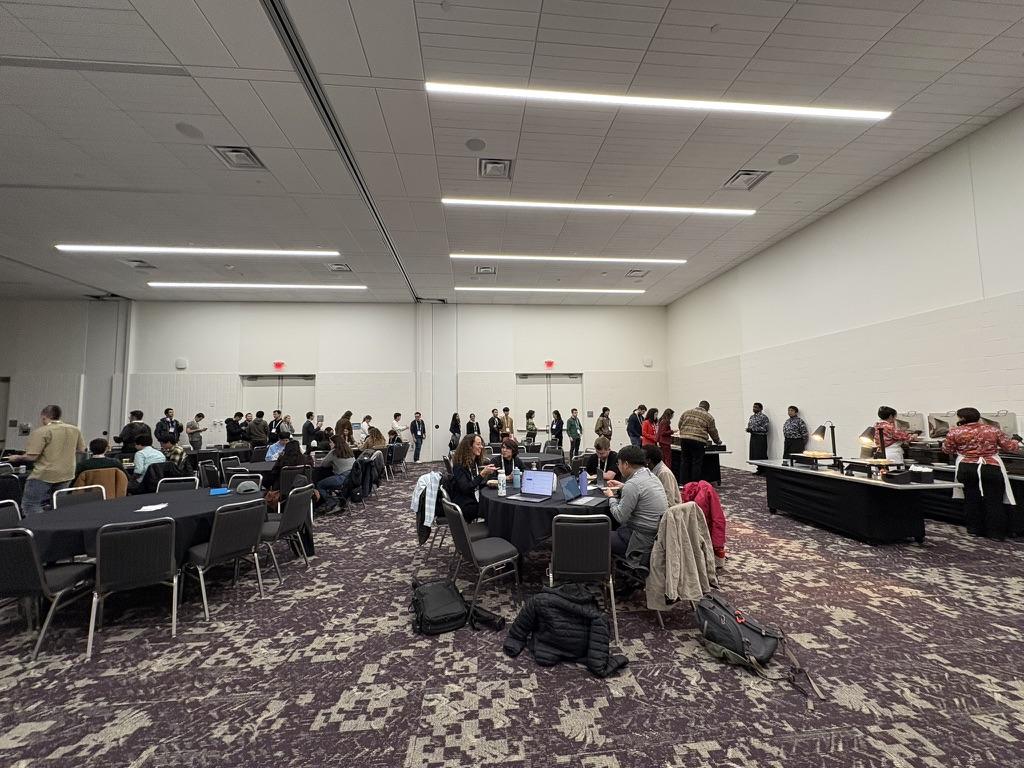 Participants gather in teams and line up to enjoy gumbo before the trivia begins.
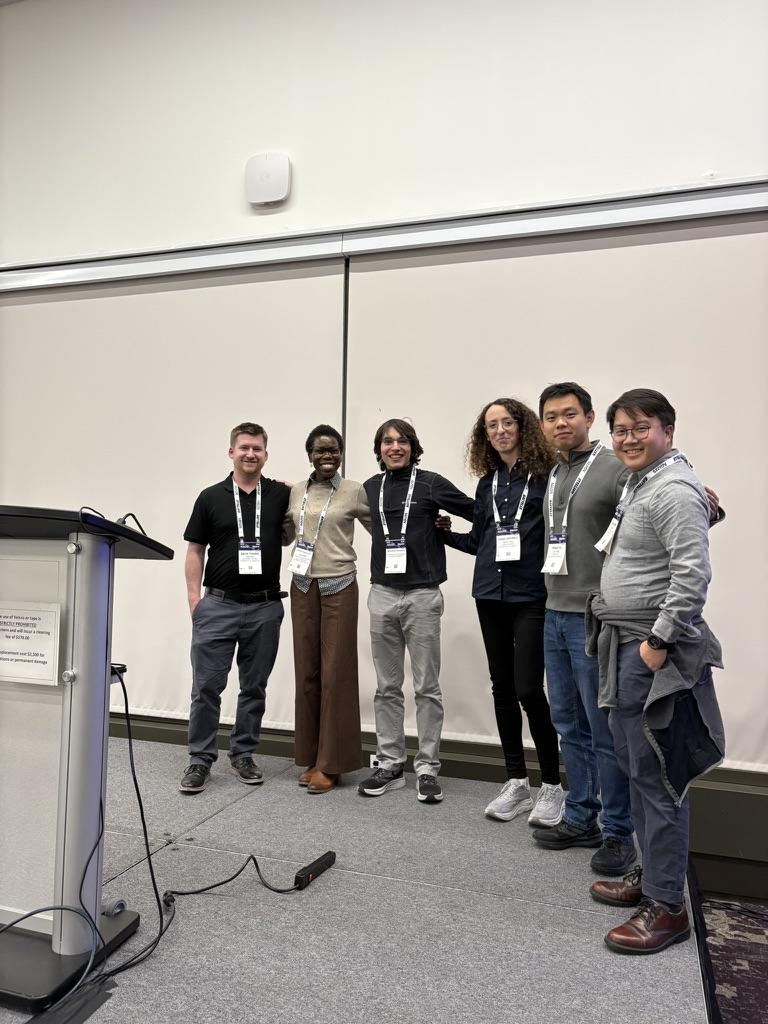 Hosts and scorekeepers representing Section student and early-career teams.
(6) Available Seminars and Webinars
Over the last few years, the number of easily accessible live or recorded seminars available to us has increased, and it can be hard to keep track of what is available. We hope the list below is useful, and please let us know if there are others we can include in future newsletters. Thank you to all the people who organize these events and save the recordings for the benefit of the greater community. Watching them alone is useful, but joining as a group or watch party can be even better—you can always pause a recording to discuss.
Also, remember that you can request a speaker through the AGU College of Fellows Distinguished Lecture Series.
(7) Seismology Tidbit
Those with keen eyes will have noticed that the seismogram on the newsletter has changed! This newsletter features the waveform from the 29 July 2025 M8.8 Kamchatka earthquake recorded at a seismic station in Pasadena (PASC in the CI network).
If you have any news, feedback, or questions, or wish to be more involved in your AGU Section, please do not hesitate to contact any member of the leadership team. We are always glad to hear from you.
Best regards,
Rachel Abercrombie
AGU Seismology Section President
Ed Garnero
AGU Seismology Section President-Elect
Martha Savage
AGU Seismology Section Past President
Elizabeth Cochran
AGU Seismology Section Secretary
William Frank
Annual Meeting Program Committee Chair
Yijian Zhou, Thanushika Gunatilake, and Cindy Lim Shin Yee
Early-Career Members and Communications Specialists
Albert Kabanda, Yifan Yu, and Richard Asirifi
Student Members of the Seismology Section Executive Committee
Bluesky: @aguseismology.bsky.social
X: @AGUSeismology
Facebook: AGU Seismology Section
Website and discussion communities: AGU Seismology
YouTube: AGU Seismology
Discord: AGU Seismology Discord
LinkedIn: AGU Seismology