May 2026 Profile: Marshall Worsham
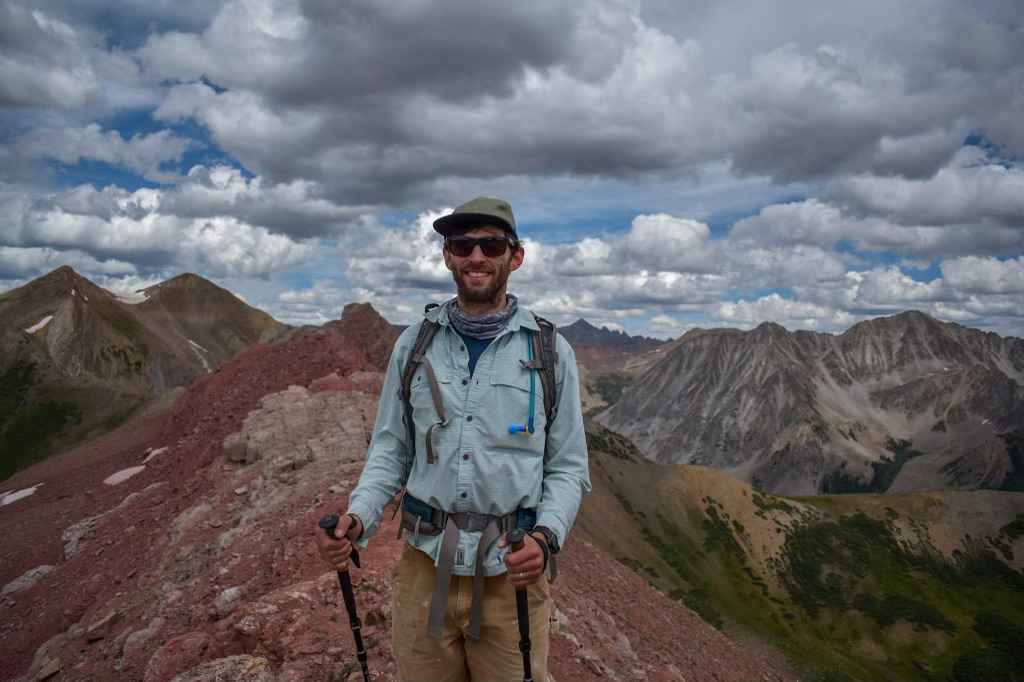
Dr. Marshall Worsham is a postdoctoral researcher in the Climate & Ecosystem Sciences Division at Lawrence Berkeley National Laboratory. He is an interdisciplinary ecologist studying how high-elevation forests are responding to emerging climate and disturbance pressures using methods in field observation, remote sensing, dendrochronology, and biometeorology. Marshall earned his PhD in Energy and Resources from the University of California, Berkeley. He also holds an MPhil in political theory from the University of Oxford and a B.A. in political science from Davidson College.
Marshall investigates how landscape properties interact to shape forest structure and function in subalpine systems. By mapping canopy structure at the plant level using full-waveform LiDAR, he has found that patterns of snow accumulation and melt are closely associated with spatial variation in forest characteristics. He also uses tree rings to understand how landscape features have buffered trees from climate extremes in the past, and the extent to which this buffering may be eroding under unprecedented warming and drying. He maintains a network of soil moisture, snow-depth, and atmospheric sensors stratified along gradients of elevation, radiation, and soil texture to quantify water movement through the root zone. His work incorporates machine learning to integrate data across spatial and temporal scales. Together, these efforts advance understanding of forest dynamics, providing land managers and modelers with actionable information as climate change accelerates in mountainous regions.
Most recently, Marshall has been completing a study evaluating the sensitivity of subalpine forest evapotranspiration (ET) to soil water potential and vapor pressure deficit (VPD) based on data from his distributed soil moisture and atmospheric sensors. Marshall also served as a co-lead for the 2025 Colorado Headwaters Ecological Spectroscopy Study. The multimodal campaign integrated an imaging spectroscopy and LiDAR acquisition with an intensive field sampling effort that captured observations of vegetation composition, foliar traits, forest demography, and subsurface geophysics. Data from the campaign are supporting an emerging body of work that will improve understanding of ecological responses to water stress in the Upper Colorado River system.